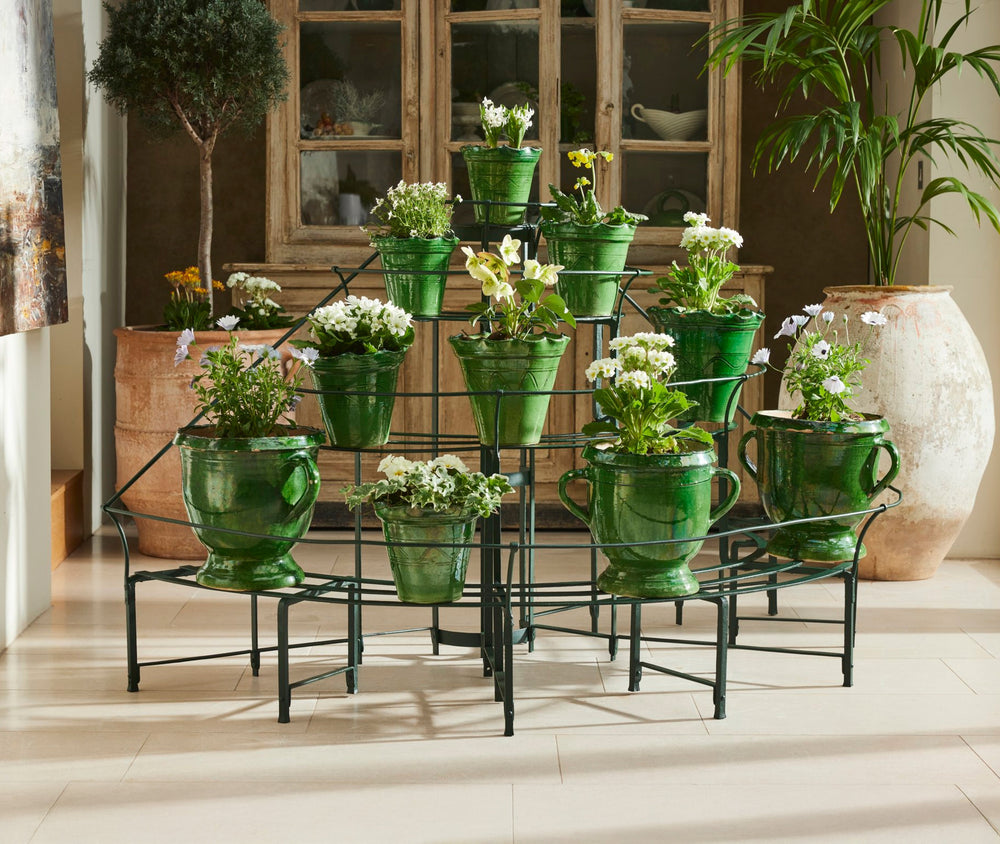

Every piece of antique garden furniture tells two stories. The first is its own, the foundry where it was cast, the hands that forged it, the gardens where it stood through a century or more of British summers and French winters.
The second is a much larger story about us: about when and why we decided that life was better lived outdoors, and how a revolution in industry and social ambition turned the garden from an aristocratic indulgence into something every family could call their own.
This is that story told through the iron, wood, and craftsmanship that furnished it. It is also, for anyone drawn to garden antiques, a guide to understanding what you are looking at and why it matters.
Before the Garden Seat: When Outdoors Belonged to the Wealthy
For most of recorded history, ornamental gardens existed for one purpose: to demonstrate power. The great formal gardens of the sixteenth and seventeenth centuries-Versailles, Hampton Court, the vast parterre layouts of the Italian Renaissance- were designed to be admired, not inhabited.
They were architectural renderings in box hedges and gravel, geometric expressions of control over nature that said everything about their owners and very little about comfort.
If furniture appeared at all, it was stone, a carved bench at the end of a vista, a seat built into an alcove wall. These were resting points within a choreographed experience, not invitations to linger.
The idea that you might drag a chair onto a lawn and simply sit there, reading or talking or doing nothing at all, would have struck a Tudor nobleman as faintly absurd. Gardens were for walking through, for showing off, for impressing ambassadors. They were not, emphatically, for relaxing in.
That would take a revolution in thinking and, eventually, a revolution in iron.
The Discovery of Outdoor Living
The shift began in the eighteenth century, in Britain. The landscape garden movement, with Capability Brown sweeping away formal parterres in favour of rolling lawns, William Kent declaring that “all nature is a garden,” and Humphry Repton carefully composing views that looked artlessly natural, fundamentally changed what a garden was for.
These new landscapes invited you in. They offered shade trees to sit beneath, lakes to contemplate, and winding paths that rewarded the wanderer. For the first time, the garden was designed around the experience of being in it rather than the spectacle of looking at it.
With this new philosophy came a new need: somewhere to sit. The earliest purpose-made garden seats were wooden, primarily oak and elm benches, often built by estate carpenters, simple in construction but perfectly suited to their setting.
They weathered to silver-grey, softening into the landscape as though they had always been there. These are among the earliest examples of what we would now recognise as antique garden benches, though precious few survive from this period.
But it was wrought iron that truly defined this era of garden furniture. Hand-forged by estate blacksmiths or local artisans, each piece of wrought iron garden furniture was genuinely unique. The material itself, a fibrous in grain, worked at the anvil rather than poured into moulds, lent itself to organic, flowing lines that echoed the naturalistic planting around them.
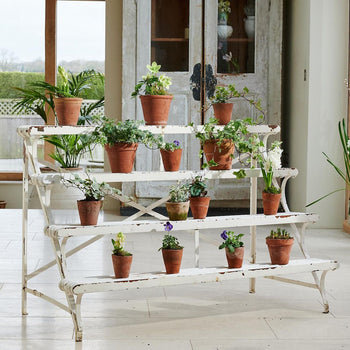
A wrought-iron plant stand or an antique garden chair from this period bears the unmistakable marks of human hands: slight irregularities in the scrollwork, the subtle texture of hammer marks, a warmth and character that no industrial process could replicate.
These pieces were made for the estates of the wealthy, one at a time, by craftsmen whose names are largely lost to us. They survive today as some of the most beautiful garden antiques in the UK and beyond precisely because they were made slowly, made well, and made to last.
Iron, Industry, and the Democratic Garden

If wrought iron furnished the gardens of the gentry, it was cast iron that opened the garden gate to everyone else. And the story of how that happened is inseparable from the larger story of Victorian Britain, a society being remade, at extraordinary speed, by industry, ambition, and an expanding middle class that wanted everything the aristocracy had, including a garden to sit in.
Cast iron changed the economics of ornament. Where wrought iron required a skilled blacksmith working metal at the forge, cast iron was produced by pouring molten metal into sand moulds, a process that could be repeated, scaled, and made affordable.
The great foundries of the nineteenth century seized on this with remarkable creative energy. The Coalbrookdale Company in Shropshire led the way, its catalogue of Victorian garden furniture displayed to international acclaim at the Great Exhibition of 1851: benches, antique garden tables, chairs, urns, and planters of astonishing intricacy.
The fern pattern bench, the oak-and-ivy design, the rustic branch motifs — these were not crude industrial products but works of genuine artistry, made possible by extraordinary skill in pattern-making.
Coalbrookdale was not alone. In Scotland, Walter Macfarlane’s Saracen Foundry in Glasgow became one of the most prolific producers of ornamental ironwork in the world, its catalogues running to thousands of designs from garden benches and antique garden ornaments to bandstands, fountains, and the elaborate park furniture that graced public spaces from Edinburgh to Bombay.
The Carron Company in Falkirk, one of the UK’s earliest industrial foundries, produced cast iron garden furniture alongside its more famous munitions. Between them, these foundries made ornamental outdoor furniture accessible on a scale unimaginable a generation earlier.
And suddenly, cast iron garden furniture was within reach. A Victorian clerk, a shopkeeper, a schoolmaster, anyone with a modest suburban villa and a patch of garden could now own an ornate bench that would have been unthinkable a generation before. The garden seat became democratic. It was a small revolution, but a real one.
The same impulse drove the great Victorian public parks movement. Birkenhead Park, opened in 1847 and designed by Joseph Paxton, was the world’s first publicly funded civic park, and it was furnished extensively with cast-iron seating.
Victoria Park in east London, Kelvingrove in Glasgow, Sefton Park in Liverpool: across the UK, antique garden benches and antique garden chairs appeared in public spaces designed to give working people access to fresh air, greenery, and the simple pleasure of sitting outdoors.
The garden bench, once the preserve of the landed estate, had become public infrastructure.
The cast iron pieces that survive from this period are remarkably robust; the material’s sheer density and weight meant they were built to endure. Look closely at an original Coalbrookdale bench, and you will often find the foundry mark cast into the frame, a quiet signature from an age when manufacturers took pride in permanence.
These marks, along with the piece’s characteristic heaviness and the crispness of its moulded detail, are the surest signs of authenticity.
Across the Channel: The French Art of Living Outdoors

While the British were furnishing their parks and suburban gardens, something quite different was happening in France — and understanding the distinction between French and British antique garden furniture begins with understanding a fundamentally different philosophy of outdoor life.
In Britain, the garden was an extension of the landscape. You sat outdoors to enjoy nature, the view, the birdsong, the particular quality of evening light on a well-kept lawn. In France, you sat outdoors to enjoy each other. The pavement café, the boulevard promenade, the hours spent in the Jardin du Luxembourg or the Tuileries.
French outdoor living was social, theatrical, and unashamedly decorative.
The garden was not a retreat from the world but an extension of the salon, moved into the open air. France’s warmer, more forgiving climate made this not merely possible but irresistible.
The resulting culture of outdoor living created a demand for garden furniture that was both vast and distinctive.
This cultural difference produced furniture of a markedly different character. French garden antiques tend toward the ornate, the romantic, the deliberately beautiful. Scrollwork is more elaborate, floral motifs are more prominent, and proportions are more elegant.
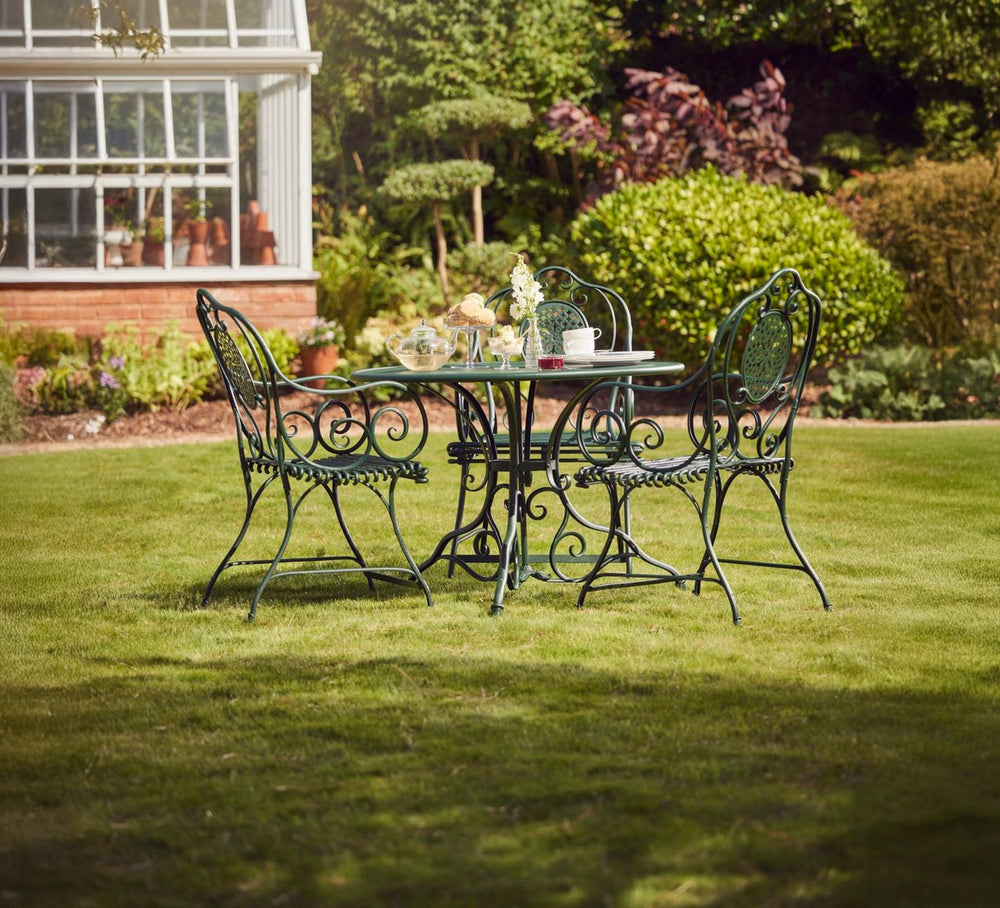
Where a British park bench says, “sit here and contemplate,” a French garden chair says, “sit here and be seen.” It is no coincidence that the antique garden bistro set, that quintessentially Parisian combination of a small round table and two chairs, designed for intimate conversation over coffee, is a French invention.
These compact, graceful sets were born on the pavements of Haussmann’s Paris and remain one of the most sought-after forms of French garden antiques today.
The great French foundries answered this demand with extraordinary sophistication. Just as Coalbrookdale had its moment at London’s Great Exhibition in 1851, France’s ironworkers had theirs at the Exposition Universelle of 1855, Napoleon III’s direct and deliberate response to the British spectacle, staged on the Champs-Élysées with over five million visitors.
The Fonderies du Val d’Osne, Barbezat & Cie, and Antoine Durenne displayed cast ironwork of breathtaking artistry: fountains, statuary, balustrades, antique garden tables, and furniture of every conceivable style, from neoclassical to rococo revival.
Paris hosted four further Expositions Universelle between 1867 and 1890, each a showcase for French decorative ironwork and a stimulus to production.
But it was in the northern town of Arras, barely a hundred miles from Paris, that one of the most distinctive traditions in French garden furniture emerged. In 1840, the firm of Grassin Baledans, one of three metalworking companies in the town, began to specialise in wrought iron garden furniture.
Their innovation was both technical and commercial. Grassin Baledans pioneered a “demi-tube” method of iron extrusion, using one curved half of a hollow iron tube rather than a flat bar. This produced furniture that was lighter, more comfortable, and more resistant to water pooling and rust than anything that had come before.
Every piece was entirely hand-forged and riveted, as welding did not yet exist. The process, however, could be scaled to meet the booming demand from Paris and beyond.
The proximity of Arras to Paris was no accident of history. With the capital’s café culture, public parks, and fashionable society all demanding beautiful outdoor furniture, Arras was ideally positioned to supply it.
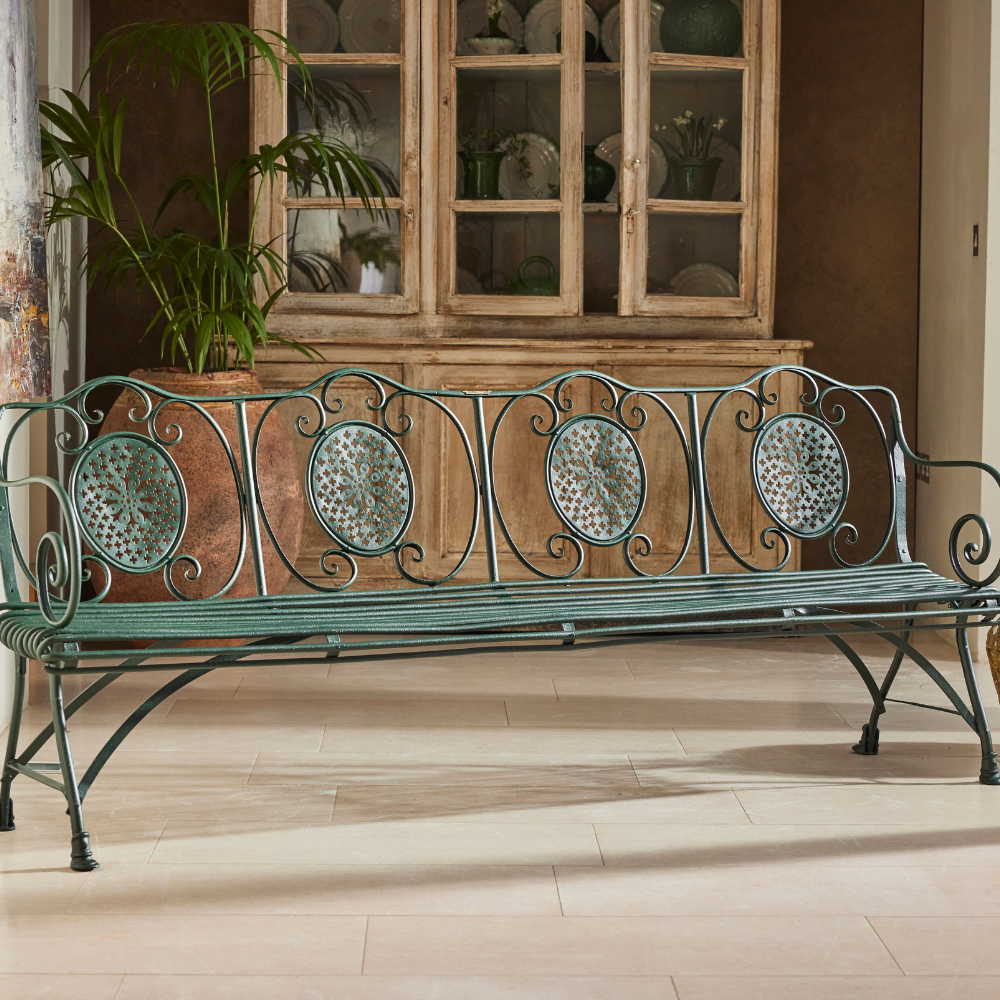
The resulting Arras garden furniture, with its characteristic, pronounced scrollwork, gently curving slatted seats, and scrolled top rails, filled the parks, boulevards, and private gardens of France throughout the late nineteenth and early twentieth centuries.
Today, original Arras pieces bearing the Grassin Baledans brass maker’s plate are among the most prized and collected French garden antiques worldwide.
The Golden Age: Edwardian Gardens and the Art of Outdoor Living
If there was a golden age of the garden, a moment when outdoor living reached a kind of perfection, it was the Edwardian era, the years between the late 1890s and the First World War.
Everything converged: the wealth of empire, the influence of the Arts and Crafts movement, and the extraordinary partnership between the architect Edwin Lutyens and the plantswoman Gertrude Jekyll, who together developed the idea of the garden as a series of interconnected “rooms,” each with its own character, its own planting, its own furniture.
Jekyll understood, perhaps better than anyone before her, that a garden was an experience to be curated. A bench placed beneath a rose arch was not just a seat; it was a destination, a focal point, a reason to walk the length of the garden.
Furniture was integral to the design, not an afterthought. The Lutyens bench, with its distinctive scrolled arms and gently curving back, became an icon of this philosophy: a piece of furniture so perfectly suited to its setting that it seemed to grow out of the garden itself.
Wood came into its own during this period. Teak, imported from the colonies, proved almost miraculously suited to outdoor use: naturally oily, resistant to rot, and able to weather to a soft, silver-grey patina that improved with every passing year. Oak endured as a native alternative, heavier and darker, with a solidity that suited the Arts and Crafts aesthetic.
The steamer chair, the garden seat, the long teak table set for an outdoor lunch, these are Edwardian inventions, born of an era that took its leisure seriously.
This was also the age of the garden party, and it is worth pausing on what that meant. An Edwardian garden party was not a casual barbecue. It was a social event of considerable importance, with its own elaborate etiquette, dress codes, and furniture, china, and accessories. An entire industry grew around it.
The matching sets of tables and chairs from this era, designed specifically for outdoor entertaining, reflect the seriousness with which Edwardians approached their leisure. The quality of your garden furniture said something about you, about your taste, your means, your place in the world. The best pieces, whether an antique garden patio set for the terrace or a teak bench beneath the copper beech, were investments, chosen to last and to impress.
It was during this period, too, that British and French sensibilities began to mingle. The eclecticism of the Edwardian era meant that a French wrought-iron table might sit perfectly happily on an English terrace, and that an ornate Val d’Osne urn could anchor an herbaceous border designed on Jekyllian principles. The rigid national distinctions softened as quality, beauty, and the sense that a piece belonged where it was placed came to matter.
What Survived, and Why It Matters

Two world wars, decades of mid-century indifference to Victorian and Edwardian ornament, and the relentless entropy of weather and neglect took their toll. Much was lost.
The wartime scrap metal drives were particularly devastating; it is estimated that only around a quarter of all Victorian cast iron work in the UK survives.
Wooden furniture, however beautiful, was always the most vulnerable. Teak endures, but oak rots, elm splits, and softwoods simply disappear. This is why original wooden antique garden furniture from before the First World War is genuinely rare, and why surviving pieces in good condition command the attention they do.
Iron proved more forgiving. Cast iron’s sheer density and weight give it a resilience that has allowed pieces to survive a century or more of outdoor exposure, often with nothing more than a rich patina of surface rust, which many collectors consider part of the piece’s character rather than a flaw to be corrected.
Wrought iron, too, endures remarkably well, its fibrous grain structure resisting the catastrophic fractures that can afflict more brittle materials. And iron takes beautifully to paint the many layers lovingly applied over the decades are themselves part of a piece’s history, creating the charming, textured surfaces that give antique garden furniture so much of its visual warmth.
Repainting, however, is sometimes the only answer to cover up extensive repairs, protect against further weathering, or address practical considerations such as rust marks that might stain your guests’ clothes.
This durability is one reason why French and British iron pieces dominate the market for garden antiques today. The pieces that have survived are, almost by definition, the ones that were well made, the best products of the best foundries and the most skilled blacksmiths. They have been tested by time and passed.
Reading a piece’s history through its surface is one of the quiet pleasures of collecting vintage garden furniture and garden antiques. A foundry mark cast into the underside of a bench tells you who made it and, often, when. A brass maker’s plate on an Arras bench confirms its provenance.
The weight of a piece in your hands, the unmistakable solidity of cast iron versus the lighter, more tensile feel of wrought iron, tells you how it was made.
The irregularities of hand-forging, the crispness of a well-preserved casting, the particular blue-grey of aged zinc, the soft silver of weathered teak: these are the signatures of authenticity, and they are almost impossible to convincingly reproduce.
There is also an argument for antique garden furniture that has nothing to do with aesthetics or history, though it is no less compelling: sustainability.
A cast-iron bench made in the 1880s has already lasted nearly a century and a half. In an age increasingly concerned with the environmental cost of disposable consumption, antique garden furniture is not merely a beautiful choice; it is the ultimate in recycling.
These pieces are, quite literally, the original sustainable option.
Every piece of antique garden furniture is an invitation to step outside, to slow down, to continue a tradition that began the moment someone first decided that the best room in the house was the one without a roof.
Today, as our gardens increasingly become another room, an extension of the house itself and as the garden room brings the outside in during the winter months, the appeal of antique garden furniture has never felt more relevant.
The materials change, the styles evolve, the centuries pass. But the impulse remains the same: to make a place in the open air, and to furnish it with something worthy of the time you will spend there.