How antique sundials connect the garden to the passage of time itself.

The Enduring Appeal of Antique Garden Sundials
There is something uniquely compelling about an antique garden sundial. More than any other garden ornament, it connects the garden to the movement of the sun, the turning of the seasons, and the passage of time itself. While clocks measure hours in mechanical increments, an antique sundial marks time through shadow and light — a gentler, more contemplative relationship with the passing day.
This quality has made antique sundials prized garden features for centuries. From the formal gardens of Renaissance Italy to the Arts and Crafts gardens of Edwardian England, the sundial has served as both a functional timekeeper and a philosophical statement.
A Brief History of Garden Sundials
Sundials are among the oldest scientific instruments, with origins stretching back thousands of years. In British gardens, they became prominent features from the sixteenth century onwards, when Tudor and Stuart gardens incorporated them as symbols of learning and sophistication.
By the seventeenth and eighteenth centuries, antique garden sundials had become essential elements of formal garden design. Skilled craftsmen produced dials of remarkable accuracy, often combining beautiful engraving with precise mathematical calibration. Many antique sundials from this period remain functional today — a testament to both their craftsmanship and the unchanging geometry of the sun's path.
Styles of Antique Sundial
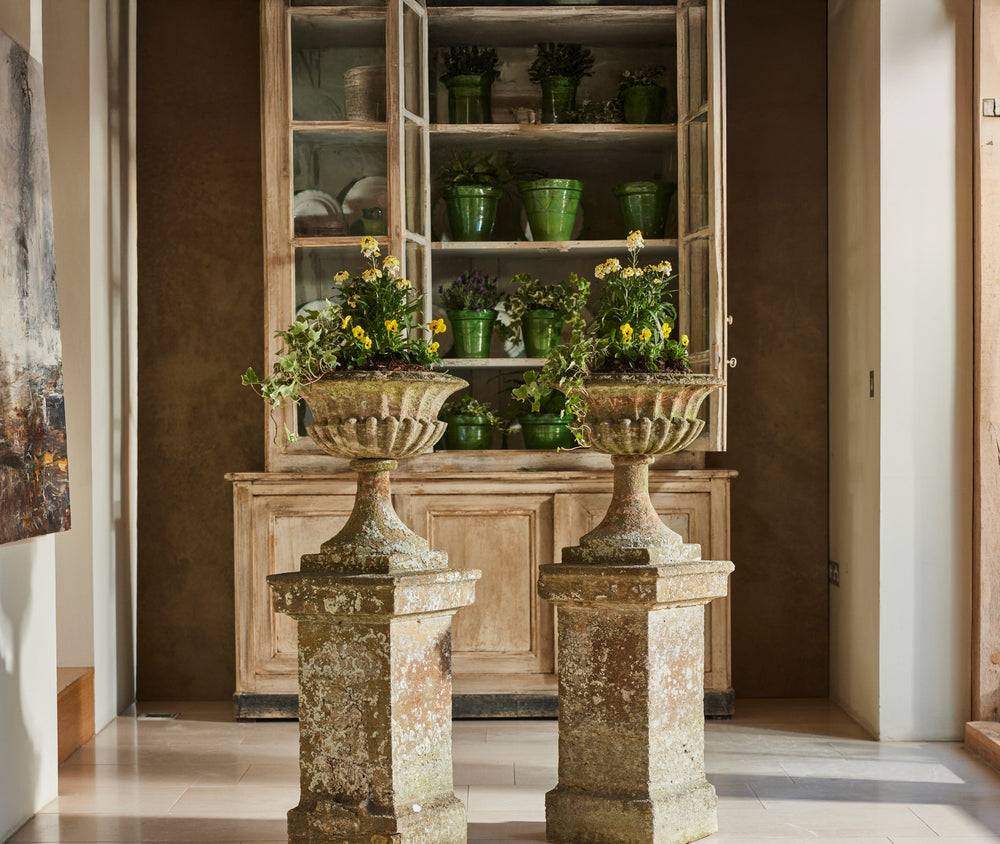
Antique garden sundials take several forms. Pedestal sundials — a horizontal dial plate mounted on a stone or metal column — are perhaps the most familiar, and the most versatile for garden use. The finest examples feature bronze dial plates that have developed rich verdigris patinas, mounted on carved stone pedestals weathered by centuries of exposure.
Wall-mounted antique sundials, designed to be fixed to south-facing walls, suit courtyard gardens and formal architecture. Armillary sundials, with their distinctive spherical framework of rings representing the celestial sphere, make striking focal points but require careful positioning to function correctly.
Lead dial plates acquire a soft, silvery finish over time, while bronze deepens to verdigris. Stone pedestals gather lichen and weather naturally, settling into the garden as convincingly as any planted element.
Sundial Mottoes and Inscriptions
Many antique garden sundials bear inscriptions — Latin mottoes, poetic phrases, or philosophical observations on the nature of time. These inscriptions add another layer of meaning, connecting the garden to centuries of reflection on mortality, transience, and the preciousness of each passing hour.
Common sundial mottoes include 'Tempus fugit' (time flies), 'Horas non numero nisi serenas' (I count only the sunny hours), and countless variations on the theme of time's passage. These inscriptions transform an antique sundial from an ornament into an object of contemplation.
Placing an Antique Garden Sundial
For an antique sundial to function, it must receive direct sunlight, which also makes it a natural focal point within the garden. Traditional placements include the intersection of paths, the centre of a parterre or knot garden, or a sunny clearing within mixed borders.
An antique garden sundial positioned at the heart of a garden creates a destination — a place to pause, check the hour, and reflect. This contemplative quality is central to the sundial's appeal. Unlike mere ornaments, an antique sundial invites interaction.
For those creating gardens intended to endure, an antique garden sundial offers something irreplaceable: a sense that the garden exists within time rather than despite it.