
Garden ornaments are often misunderstood. For some, they conjure images of decorative excess objects that feel stranded on a lawn rather than settled into it. Yet this view overlooks a long and thoughtful tradition in which antique and vintage garden ornaments played a fundamental role in shaping gardens of lasting beauty.
In well-designed gardens, particularly those that mature and deepen over decades, it is the permanent elements that hold everything together. Antique garden statuary. A weathered stone trough planted with alpine succulents. Staddle stones marking a threshold. A vintage bird bath catching winter light.
These are the pieces that remain when borders fade and seasons turn. Crafted from traditional materials and allowed to weather naturally, they become part of the landscape rather than additions to it.
For those seeking to create gardens with real depth and longevity, antique garden ornaments are not a decorative afterthought. Rather, a design essential.
Antique Bird Baths: Function, Beauty, and Year-Round Presence
Of all antique garden ornaments, the antique bird bath occupies a unique position. It is simultaneously functional and sculptural, a piece that earns its place through both purpose and beauty.
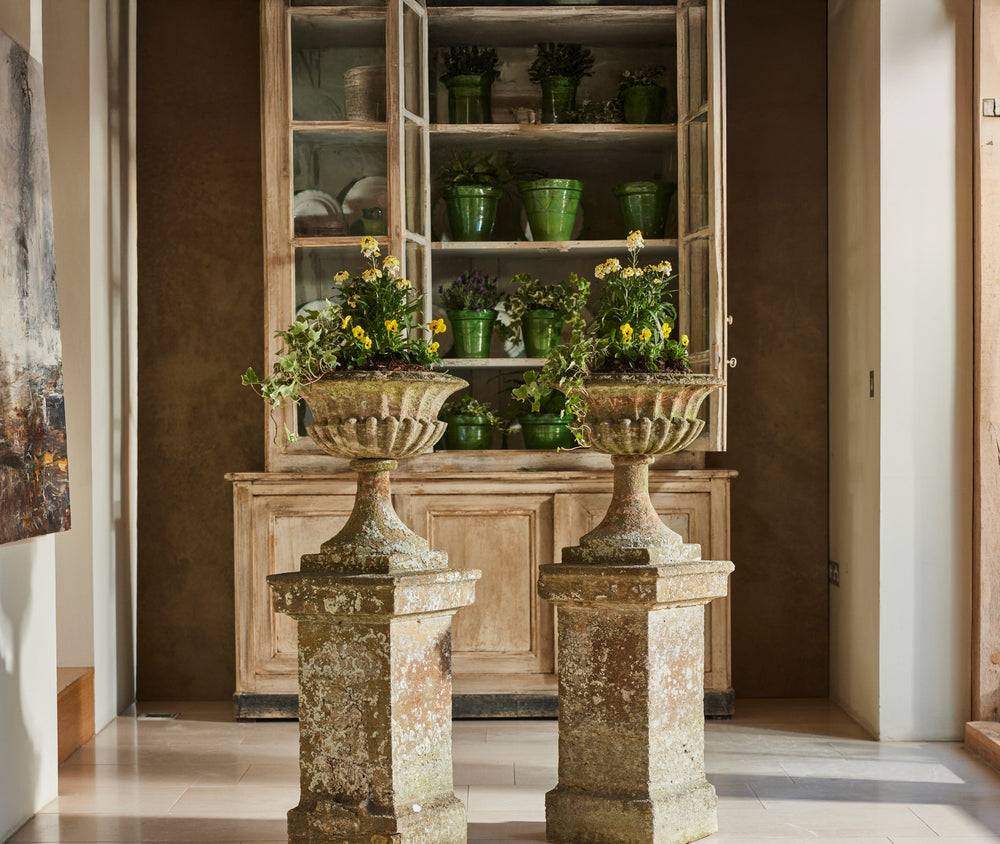
The finest antique bird baths, whether carved from stone, cast in lead, or formed from reconstituted materials in the early twentieth century, share certain qualities: generous proportions, a weathered surface that catches light, and a form that feels inevitable rather than imposed.
Positioned where planting softens its edges, perhaps at the meeting point of borders, or as a focal point within a walled garden, am antique bird bath provides structure in winter while drawing life into the garden year-round.
Unlike modern reproductions, antique bird baths carry the patina of decades. Lichen, mineral deposits, and the softening of crisp edges all contribute to their presence. They do not look placed. They look as though they have always been there.
Antique Sundials: Marking Time in the Garden
There is something uniquely compelling about an antique sundial. More than any other garden ornament, it connects the garden to the movement of the sun, the turning of the seasons, and the passage of time itself.
The best antique sundials, whether mounted on stone plinths, set into walls, or standing on period pedestals, possess a quiet authority. They ask nothing of the viewer but repay attention with detail: Roman numerals worn smooth, a gnomon casting its daily arc, inscriptions half-legible after centuries of weather.
For those creating gardens intended to mature over generations, an antique sundial offers something irreplaceable: a sense that the garden exists within time rather than despite it.
Positioned at the intersection of paths, at the centre of a parterre, or simply where the light falls longest, a vintage sundial provides year-round structure and a point of contemplation that planting alone cannot achieve.
Antique Garden Statuary: The Art of Placement
Garden statuary is perhaps the most misunderstood category of antique garden ornament, largely because it is too frequently displayed rather than integrated.
When used properly, antique garden statuary terminates paths and sightlines with quiet authority, establishes scale within planting, introduces narrative, mythology, or symbolism, and provides structure that reads as clearly in January as in June.
The most convincing vintage garden statues are rarely centre stage. They are framed by planting, partially obscured by foliage, or encountered unexpectedly at the turn of a path. This sense of discovery is what allows antique statuary to feel timeless rather than theatrical.
Whether a classical figure, a stone putti, or a lead animal, it is not the subject that matters most but proportion, material quality, and the statue's relationship to its surroundings.
Staddle Stones: Architectural Salvage With Presence
Among architectural salvage, staddle stones occupy a special place in the English garden tradition.
Originally designed to support granary buildings, their distinctive mushroom form preventing rats from climbing to stored grain, staddle stones have been repurposed as garden ornaments for well over a century. Their agricultural origins give them a rooted, unpretentious character that suits both formal and informal settings.
A pair of staddle stones flanking an entrance. A group marking the transition from lawn to orchard. A single staddle stone standing sentinel at the corner of a border. In each case, these pieces bring scale, permanence, and material honesty without demanding attention.
The finest antique staddle stones show their age through lichen growth, weathering, and the softening of once-crisp edges. They suit contemporary gardens as readily as period ones - their sculptural simplicity reads as modern even as their material speaks of centuries past.
Stone Troughs: Enduring Appeal
Antique stone troughs are among the most versatile pieces of architectural salvage available to gardeners today.
Originally used as water troughs, feeding troughs, or sinks, these hand-carved vessels now serve as containers for alpines, succulents, or simple seasonal planting. Their thick walls, worn surfaces, and irregular proportions give them a presence that modern containers cannot replicate.
A stone trough positioned on a terrace, beside a doorway, or as the focal point of a courtyard garden brings immediate maturity. Planted sparingly or left empty to catch rainwater and reflect the sky, it offers year-round structure and texture.
Stone troughs work particularly well in modern settings. Their elemental simplicity and honest materiality complement clean architecture, softening hard landscaping while introducing the depth that only age can provide.
Materials That Reward Patience
One of the defining characteristics of antique and vintage garden ornaments is how they age.
Stone softens and gathers lichen. Lead develops a quiet, silvery patina. Bronze deepens to verdigris over decades. Cast iron weathers to a texture that speaks of winters endured.
These materials respond to weather, light, and season, gradually becoming more visually convincing with each passing year. This slow transformation is central to why traditional garden ornaments, whether antique sundials, antique bird baths, or reclaimed staddle stones, feel at home outdoors in ways that modern reproductions never quite achieve.
Gertrude Jekyll and the Principle of Restraint
The work of Gertrude Jekyll offers an invaluable lesson for anyone using antique garden ornaments today.
Working from the late nineteenth century into the early decades of the twentieth century, Jekyll shaped what we now recognise as the Arts and Crafts garden. Trained as an artist, she approached planting with a painter's understanding of colour and composition, but she also understood the role of permanent structure.
In her gardens, ornaments were never isolated. Antique sundials were positioned where paths met. Vintage statuary emerged from planting rather than standing apart from it. Stone troughs and bird baths were absorbed into borders, their edges softened by foliage.
Crucially, Jekyll avoided spectacle. Her ornaments felt settled and inevitable - part of the garden's fabric rather than additions to it.
For anyone building a collection of vintage garden ornaments, her work reinforces the idea that quality, restraint, and placement matter far more than quantity.
Learn more about Jekyll’s work.
Choosing and Placing Antique Garden Ornaments
Successful use of antique and vintage garden ornaments depends less on acquisition and more on understanding.
When considering a piece, whether an antique bird bath, a pair of staddle stones, a vintage sundial, or a reclaimed stone trough, several questions matter.
Scale: How will the piece read within its intended setting? An ornament that feels commanding in a dealer's yard may disappear in a large garden or overwhelm a small courtyard.
Material: How will the surface weather and age? Stone and lead improve with time. Some reconstituted materials do not.
Winter presence: How will the piece look when planting has retreated? The best antique garden ornaments earn their place in January as convincingly as in June.
Resolution: Does the ornament complete a view, anchor a moment, or provide a destination? The strongest placements feel inevitable rather than arbitrary.
An antique garden ornament should support the garden's underlying structure. It should never compete with it.
Antique Garden Ornaments in Contemporary Settings
A common hesitation is whether vintage garden ornaments belong in modern gardens. In practice, contrast often strengthens design. Just as interior designers mix antiques with contemporary architecture to add warmth and depth, gardens benefit from the same approach.
A weathered stone trough against a clean rendered wall. Staddle stones punctuating a minimalist gravel garden. An antique sundial catches light on a modern terrace. These combinations work because antique garden ornaments bring qualities that new pieces cannot replicate. Material depth, the softness of age, and the sense that something has been chosen rather than merely purchased.
What matters is clarity of intention, not stylistic purity. Often, a single well-chosen antique ornament achieves more than multiple additions ever could.
Creating Gardens That Last
Antique and vintage garden ornaments are not about nostalgia. At their best, they provide what gardens most need: structure, permanence, and meaning within living landscapes.
A vintage bird bath that draws blackbirds in winter. An antique sundial marking the hours as borders rise and fall around it. Staddle stones and stone troughs that anchor a garden through decades of change.
When chosen with care and placed with restraint, these pieces enhance gardens in ways that planting alone cannot. They bring clarity in winter, depth over time, and the sense that a garden has found its equilibrium.
In the most successful gardens, antique ornaments do not draw attention to themselves. They simply belong.
Which is, of course, precisely the point.